For informational purposes only. Not a substitute for veterinary advice. Consult your veterinarian for specific medical decisions.
Follow product labels; observe the animal closely, and seek qualified veterinary help when signs persist or worsen.
Quick Answer
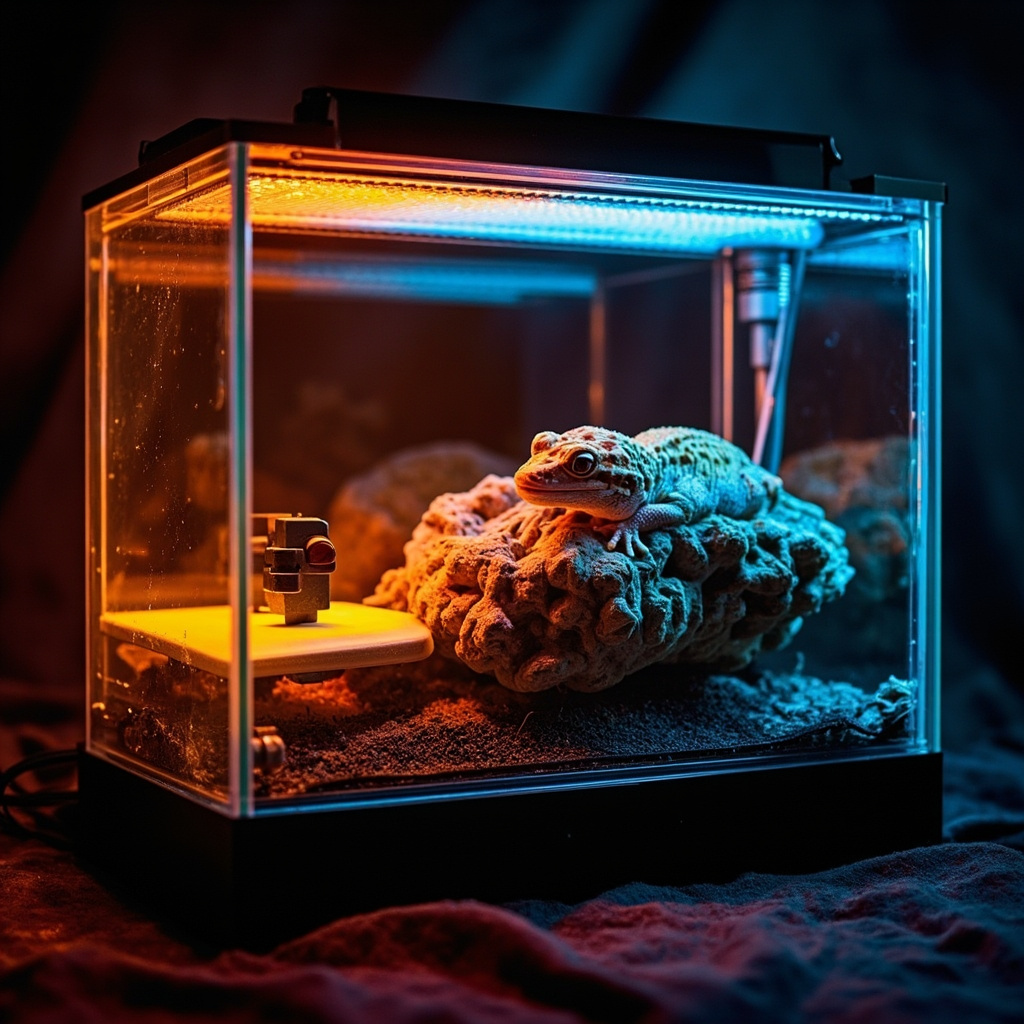
Leopard geckos need a 20-gallon tank (30x12 inches floor space) as adults. Juveniles under 6 months can start in 10-gallon tanks, but adults require at least 20 gallons for proper thermal gradient and movement. Front-opening glass terrariums are preferred over top-opening aquariums. Floor space matters more than height — leopard geckos are terrestrial, not climbers.
Minimum Tank Size by Age
Reviewed against the sources cited below. Last updated: 2026-07-16.
Leopard geckos grow quickly in their first year, and their enclosure should grow with them. A tank that is perfect for a hatchling will feel cramped by the time the gecko reaches adulthood. Below are the generally accepted minimum sizes based on age and life stage.
Hatchlings and Juveniles (0-6 Months): 10 Gallons
Young leopard geckos under 6 months do well in a 10 gallon enclosure with a footprint around 20 x 10 inches. At this stage, they are small and tend to stay close to their hide. A smaller tank makes it easier for them to find food, water, and their warm hide without expending too much energy.
The downside of a small enclosure is limited room for a thermal gradient. Even in a 10 gallon, you should maintain distinct warm (85-90°F) and cool (70-75°F) zones. See our leopard gecko temperature guide for setup details.
Sub-Adults (6-12 Months): 15-20 Gallons
Between 6 and 12 months, leopard geckos reach roughly 6 to 8 inches in length and become more active. A 15 to 20 gallon enclosure gives them enough floor space to explore while still maintaining a reliable temperature gradient. Many keepers skip the intermediate size entirely and move straight to a 20 gallon at this stage.
Adults (12+ Months): 20 Gallon Minimum
A 20 gallon long tank (30 x 12 x 12 inches) providing roughly 360 square inches of floor space is the widely accepted minimum for a single adult leopard gecko. This size allows for three distinct zones: a warm basking area over the heat mat, a cool zone on the opposite end, and a middle transition zone.
A 20 gallon front-opening terrarium like the REPTI ZOO is a popular choice because the front doors make feeding and cleaning much easier than top-access tanks.
If you plan to house two females together — which requires careful introduction and monitoring — a 30 to 40 gallon tank is the minimum. Never house two males together. For more on social behavior, see our leopard gecko shedding guide.
Recommended (Not Just Minimum) Tank Size
A 20-gallon long enclosure is the widely accepted floor for an adult leopard gecko, but experienced keepers increasingly recommend going larger. A 30-gallon or 40-gallon breeder (36x18x16 inches, roughly 720 square inches of floor space) is often called the upgrade sweet spot because it gives you enough room for the three-hide rule plus clutter and a true warm-to-cool gradient without compromising heat distribution.
Why 20 Gallon Is the Floor, Not the Ceiling
Twenty gallons meets the minimum biological needs of a single adult, but it constrains how many enrichment features you can fit. Adding a humid hide, two dry hides, a water dish, and decor quickly crowds a 30x12 inch footprint, leaving little open floor for the gecko to walk.
30 Gallon / 40 Gallon Breeder: The Upgrade Sweet Spot
The 40-gallon breeder (36x18x16 inches) is the most popular upgrade size because it doubles floor space over a 20-gallon long without raising height into the danger zone. It also accommodates the BN-LINK reptile thermostat ($16.99), which keeps the under-tank heater at a precise basking temperature without hot spots.
When Bigger Becomes a Problem
Anything above 40 gallons can actually be counterproductive in a cool room. A very large tank is harder to heat evenly with an under-tank heater alone; you may need to add overhead basking or ceramic heat emitters to maintain the warm end. For enclosure material comparisons, see our terrarium selection guide.
Floor Space vs Height — Why It Matters
Leopard Geckos Are Terrestrial
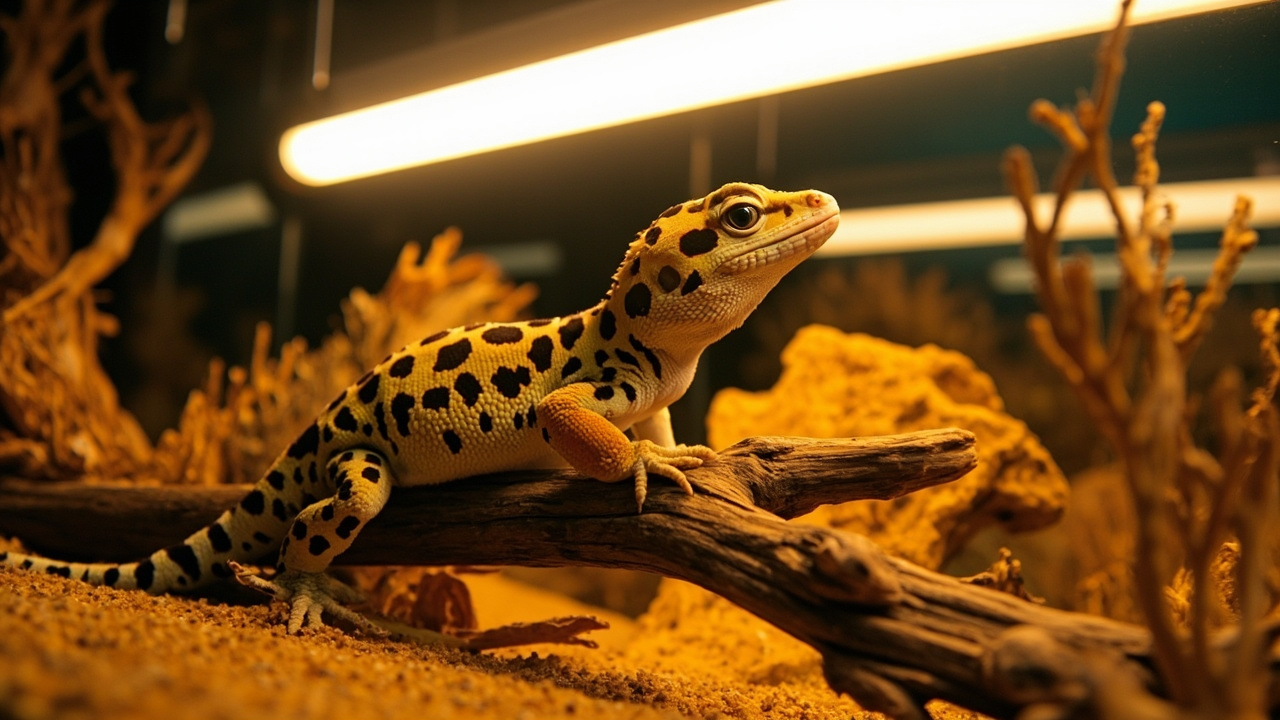
Unlike crested geckos or arboreal snakes, leopard geckos spend nearly all their time on the ground. They do not climb branches or scale glass walls. Their natural habitat consists of rocky outcrops and dry grassland where they move horizontally across flat surfaces.
This means floor space is the single most important dimension. A tall 20 gallon tank that is 24 inches high but only 12 inches wide offers less usable space than a 20 gallon long that is 30 inches long and only 12 inches high.
Minimum Floor Space Requirements
For a single adult leopard gecko, aim for at least 360 square inches of floor space (30 x 12 inches). This provides enough room for a warm hide, a cool hide, a humid hide, a water dish, and open ground for hunting insects.
For two cohabiting females, double the floor space to at least 720 square inches (typically a 40 gallon breeder at 36 x 18 inches).
Use our tank size calculator to compare different tank dimensions and see which option gives you the most usable floor space for your available room.
Why Bigger Is Better
More Room for a Thermal Gradient
A proper thermal gradient is essential for leopard gecko health. The gecko needs to move between warm and cool zones to regulate its body temperature. In a small tank, the heat source warms the entire enclosure too quickly, leaving no cool retreat. This forces the gecko to choose between overheating and staying too cold. Proper UVB placement depends on having enough room — see our leopard gecko UVB guide for fixture positioning.
A larger tank creates a natural buffer zone. The warm end stays at 85-90°F while the cool end remains at 70-75°F, with a gradual transition in between. This setup supports normal digestion, feeding behavior, and activity cycles.
Enrichment and Exercise
In the wild, leopard geckos cover significant ground during their nightly hunts. A larger enclosure lets them walk, explore, and stalk prey more naturally. Keepers who upgrade from 20 gallons to 40 gallons often notice their geckos become more active and display more natural hunting behaviors.
Adding low-height decor — flat rocks, cork bark, and small climbs — gives the gecko terrain to navigate without risking falls from dangerous heights. For feeding tips in a new enclosure, check our leopard gecko diet guide.
Heating & Temperature Gradient
Leopard geckos are ectothermic — they rely on external heat sources to regulate their body temperature. A proper thermal gradient lets the gecko self-regulate by moving between warm and cool zones, which directly supports digestion, immune function, and overall activity. Modern husbandry standards from reptile care authorities like ReptiFiles recommend a warm-side floor surface temperature of 88–95°F (measured with an infrared thermometer or probe) and an ambient cool-side temperature of 70–78°F. Night drops into the high 60s°F are safe and replicate the natural desert cycle.
Heat Mat (UTH) vs Ceramic Heat Emitter (CHE) vs Halogen
Three heating options dominate leopard gecko husbandry, each with pros and cons:
- Under-tank heater (UTH) — A heat mat placed under one end of the enclosure. The classic choice for belly heat, mimics the warm rocks leopard geckos rest on after dusk. Works well in glass and PVC tanks. Must be paired with a thermostat to prevent burns.
- Ceramic heat emitter (CHE) — A screw-in bulb that emits heat without light. Useful as a 24-hour supplemental heat source in cold rooms or during winter nights. No visible light disrupts the day/night cycle.
- Halogen flood light — Once considered risky for crepuscular geckos, halogen is gaining support in 2024+ because it produces infrared-A and infrared-B wavelengths that penetrate deeper into tissue than a heat mat, mimicking sunlight more naturally. Best used overhead in a domed fixture.
Why Leopard Geckos Benefit from Halogen Now (2024+ Paradigm Shift)
Older care sheets treated leopard geckos as strictly nocturnal and argued against overhead lighting. Modern research, summarized in ReptiFiles’ leopard gecko care guide and supported by the Bio Dude’s bioactive methodology, shows that crepuscular species benefit from short bursts of infrared-A just like diurnal lizards. A low-wattage halogen on a 12-hour timer paired with a T5 HO UVB is increasingly the recommended setup.
Thermostat Setup
A thermostat is not optional — it’s the single most important piece of safety equipment in a heated enclosure. Three thermostat types are common:
- On/off thermostat — Switches the heat source fully on or fully off when temperature drifts. Budget friendly but causes slight temperature swings.
- Dimming thermostat — Ramps voltage up and down to control output smoothly. Best pairing for halogen bulbs and CHEs.
- Pulse proportional thermostat — The most precise option, used for sensitive species. Slightly overkill for leopard geckos but excellent.
Pair any thermostat with a digital probe thermometer on the warm side to confirm actual surface temperatures.
Day/Night Cycle
Leopard geckos need a 12-hour-on / 12-hour-off photoperiod to maintain healthy circadian rhythms. All overhead lights — halogen, UVB, ambient room lights in the gecko’s room — should run on a timer or be turned off manually at the same time each evening. For full lighting and heating setup, see our lighting and heat guide.
Cool Side vs Warm Side vs Middle Zone
In a properly set up 20-gallon long or larger, three zones should be clearly distinct:
- Warm side — 88–95°F floor surface directly above the heat mat or under the halogen; place the warm hide here
- Middle / transition — 78–85°F; open floor space where the gecko digests meals
- Cool side — 70–78°F; place the cool hide and water dish here
Recommended Enclosures
Glass Terrariums with Front-Opening Doors
Front-opening glass terrariums are the standard choice for leopard gecko housing. The doors allow easy access for feeding, spot cleaning, and handling without removing the entire lid. Look for models with:
- Tempered glass for safety and durability
- Screen ventilation on the lid to prevent moisture buildup
- Front-opening doors for stress-free access
- Horizontal footprint (longer than tall)
For enclosure layout ideas, our terrarium selection guide covers what to look for when choosing between glass, PVC, and acrylic options.
What to Avoid
Fish tanks with mesh lids: These work in a pinch but have two drawbacks. The top-only access means you have to reach in from above, which can stress the gecko. Mesh lids also make it harder to mount UVB fixtures securely.
Tall or vertical enclosures: Tanks marketed for arboreal reptiles or tree frogs are wasted on leopard geckos. The extra height does not add usable space and can even be a fall risk if the gecko climbs the silicone seams.
Plastic storage containers: While popular for breeding racks, storage tubs are not ideal for display enclosures. They lack ventilation, do not hold a heat gradient well in thin plastic, and make temperature monitoring difficult. Our bearded dragon shedding guide also covers enclosure environment tips that apply broadly.
Substrate for Leopard Gecko
Substrate choice is one of the most debated topics in leopard gecko care because it directly affects impaction risk, humidity control, and naturalistic appearance. The “right” answer depends on the gecko’s age, your experience level, and how closely you can monitor feeding. For a broader substrate comparison across species, see our reptile substrate guide.
Paper Towel (Quarantine + Hatchling)
Plain paper towels are the gold standard for hatchlings, new arrivals, and quarantine enclosures. They are zero-risk for impaction, allow you to spot clean instantly, and let you monitor feces for signs of internal parasites. The downside is aesthetic — paper towels look clinical and need to be replaced every few days.
Slate / Ceramic Tile (Popular + Safe)
Slate or ceramic tiles are the most popular choice for adult leopard geckos. They conduct heat evenly across the warm side, hold belly heat from an under-tank heater, and are completely impaction-safe. Tiles should be cut to fit the enclosure floor with a small gap for the heat mat cord. The Zilla Terrarium Liner 2-Pack (40/50 gal) ($26.07) is a cut-to-fit liner option for a 40-gallon breeder floor.
Bioactive (Advanced + Naturalistic)
A bioactive setup uses a layered substrate (drainage layer, substrate mix, leaf litter) seeded with live cleanup crew isopods and springtails that break down waste. Bioactive is more work to set up but reduces long-term cleaning. It only works in a fully planted, well-ventilated enclosure with a proper drainage layer — not in a glass tank with a 1-inch substrate layer.
Why Loose Sand Is Controversial
The sand debate has run in reptile communities for over a decade. The traditional argument against it is impaction risk: a gecko that ingests sand while hunting can develop intestinal blockages that require surgery. Proponents argue that wild leopard geckos live on sandy substrates and a captive gecko with proper heat and hydration can pass small amounts of sand safely.
Modern consensus is split. ReptiFiles recommends against loose sand for any leopard gecko under 12 months and suggests tile or paper towel for adults. The Bio Dude sells bioactive mixes that include washed play sand as a minor component rather than pure sand. If you do choose loose substrate, use fine-grain washed play sand (not calcium sand, which clumps), avoid feeding on the sand surface, and provide a humid hide to prevent dehydration.
Substrate Depth and Humidity Interaction
Deeper substrates hold humidity longer, which is helpful in dry winter months but problematic if it allows the floor to stay damp. For leopard geckos, keep total substrate depth under 2 inches unless running a fully bioactive setup with drainage. Pair substrate choice with a properly maintained humid hide (covered in the next section).
Hides & Enrichment
Leopard geckos are shy, crepuscular lizards that spend most of the daylight hours inside a hide. A well-designed hide setup is essential to their psychological health and supports normal thermoregulation, shedding, and digestion. For tips on how hides interact with shedding, see our leopard gecko shedding guide.
The 3-Hide Rule
Every leopard gecko enclosure needs at least three hides, one for each zone:
- Warm hide — placed directly over the heat source; provides a hot retreat for digestion
- Cool hide — placed on the opposite end; offers a temperature escape when the gecko needs to cool down
- Humid hide — placed in the middle or slightly toward the warm side; filled with damp sphagnum moss to support shedding
Humid Hide Setup
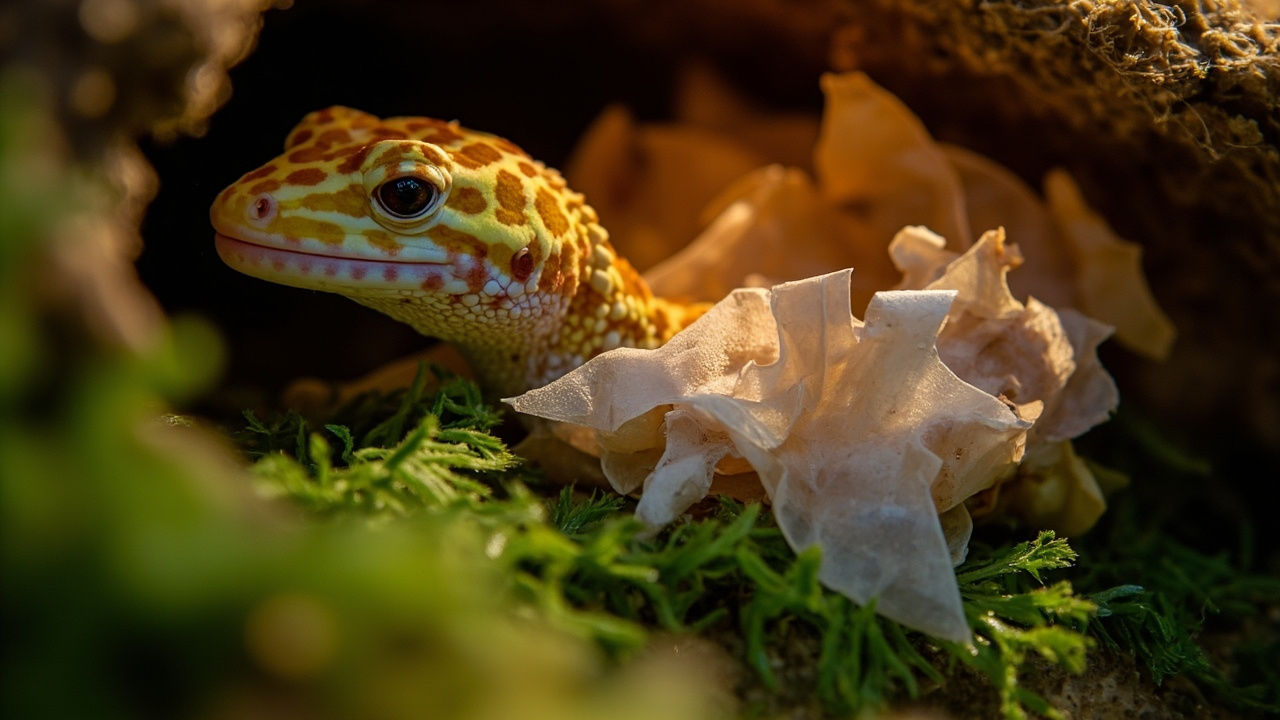
The humid hide is the most under-appreciated piece of the enclosure. Fill a small plastic container or commercially made reptile hide with moistened sphagnum moss or paper towels. Mist it lightly every 2–3 days. The humidity inside the hide should sit around 70–80% while the ambient enclosure humidity stays lower at 30–40%. Without a humid hide, leopard geckos often develop stuck shed on their toes and tail tips, which can cut off circulation and lead to lost digits.
Clutter and Cover
Beyond the three hides, add visual clutter to make the gecko feel secure. Fake plants, cork bark rounds, flat rocks, and small branches give the gecko paths to navigate and sight lines to break. Leopard geckos prefer low-traffic enclosures where they can move from one covered spot to the next without crossing open floor.
Feeding Tongs vs Free-Range Feeding
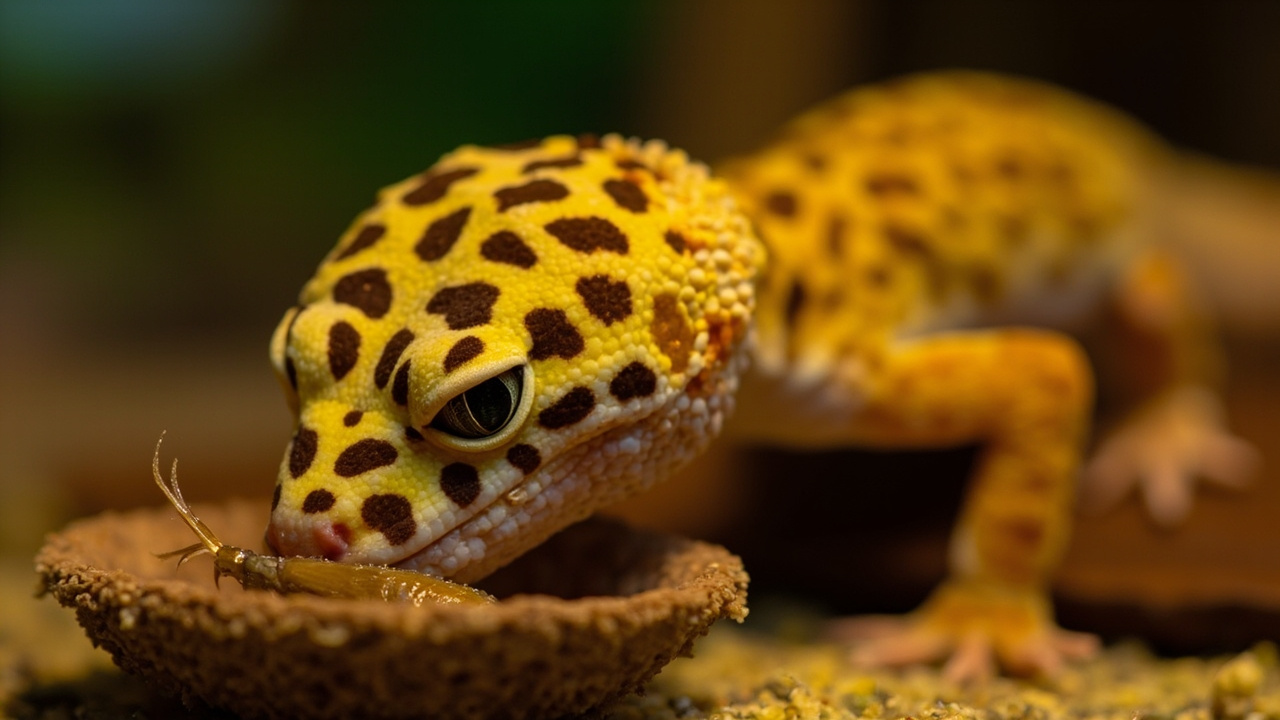
Feed insects with tongs to prevent accidental substrate ingestion. Drop the insect in front of the gecko, watch it consume the prey, and remove any uneaten insects within 15 minutes. Free-ranging crickets can hide in the enclosure and stress the gecko, plus they may bite back during the gecko’s sleep cycle.
Lighting & UVB
Leopard geckos can survive without UVB if their diet is supplemented with vitamin D3 and calcium. However, modern husbandry standards increasingly support low-level UVB as a way to mimic natural conditions and improve long-term immune function.
The 2024 Paradigm Shift (Low-Level UVB Recommended)
Older care sheets argued that leopard geckos didn’t need UVB because they’re nocturnal and could get D3 from supplements alone. Updated guidance from ReptiFiles, the Bio Dude, and several reptile veterinarians now recommends low-level UVB (2–5% Ferguson Zone 1) as a long-term health booster. UVB supports natural vitamin D3 synthesis, improves calcium metabolism, and strengthens immune response.
Shade Dweller 7% / Arcadia 6% for Leopard Geckos
Two T8 or T5 HO tubes are commonly recommended for leopard geckos:
- Arcadia Shade Dweller 7% — designed specifically for Ferguson Zone 1 species like leopard geckos and crested geckos
- Zoo Med Reptisun 5.0 T5 HO — slightly stronger, but works at greater distance
Mount the fixture overhead, not through glass (glass blocks most UVB output). For full placement guidance, see our leopard gecko UVB guide.
UVB Fixture Placement
Position the UVB fixture so the gecko can self-regulate exposure by moving between the lit zone and the hides. A 12-hour timer matched to ambient room lighting gives the gecko a natural photoperiod without over-exposure.
Photoperiod and Day/Night Cycle
UVB should run 10–12 hours per day, synchronized with the heat source. At night, all overhead lights should turn off to allow the gecko’s natural melatonin cycle. Ambient room light that remains on after sunset can confuse the photoperiod — consider blackout curtains in brightly lit bedrooms.
Cohabitation: Why It Usually Fails
Leopard geckos are solitary reptiles in the wild, and captive cohabitation carries significant risk even between same-sex pairs. The “leopard gecko tank size” question often comes with a follow-up about housing two geckos together — here is what experienced keepers recommend.
Male + Male = Always Fails
Two males will fight, often to the death. Territorial aggression starts with arm-waving displays and escalates to biting. Never house two males in the same enclosure regardless of tank size.
Female + Female = Sometimes Works (Size Matters)
Two females can sometimes cohabit if they are similar in size, introduced as juveniles, and housed in a 40-gallon breeder or larger with separate feeding stations and three hides each. Even successful female pairs can break down as they mature, so monitor closely for signs of dominance.
Tank Size for Cohabitation
The minimum for any cohabitation setup is a 40-gallon breeder (36x18x16 inches, roughly 720 square inches). Larger is better — a 75-gallon or 120-gallon enclosure gives each gecko enough space to establish its own territory.
Signs of Stress to Watch For
- Tail waving or arm waving displays
- One gecko monopolizing the warm hide while the other hides in the cool end
- Weight loss in the subordinate gecko
- Bite marks on legs or tail
- Constant hiding from the dominant gecko
If any of these signs appear, separate the geckos immediately. Cohabitation should never be attempted for beginners — even experienced keepers often find that single-gecko housing eliminates these problems entirely.
Setting Up the Right Tank
Using the Tank Size Calculator
Choosing between a 20 gallon long, a 20 gallon standard, and a 40 gallon breeder can be confusing because the labels do not tell you the actual dimensions. Our tank size calculator converts gallons to dimensions and calculates usable floor space so you can compare options side by side.
For a single adult leopard gecko, the key number to watch is floor space. Anything with 360 square inches or more meets the minimum. Anything above 600 square inches is generous and will give your gecko plenty of room to stay active and healthy.
Pair the right enclosure with a good substrate setup and proper heating, and your leopard gecko will have a healthy foundation for years to come.
Upgrading Tank Size: When and How to Size Up
Most keepers buy a small tank for a hatchling and a larger tank for the same gecko as an adult, but the timing and method of the upgrade matter more than the final size. Move a leopard gecko too early and it struggles to find food; move it too late and you stunt its growth, force a cramped thermal gradient, and risk obesity from lack of exercise. The upgrade is one of the most important leopard gecko habitat decisions you’ll make in the first 18 months.
From 10 Gallon to 20 Gallon: 6-9 Months
A hatchling in a 10 gallon enclosure typically outgrows it by 6-9 months, when it reaches 6-7 inches snout-to-vent length (SVL). At that size, it has outgrown a 20x10 inch footprint and needs a longer enclosure to thermoregulate. The move is non-negotiable — adult-sized leopard geckos in a 10 gallon develop muscle loss, obesity, and chronic stress.
The tell-tale signs your gecko is ready to upgrade are:
- Body length approaching the full width of the tank (the gecko fills the 10 inch width nose-to-base-of-tail)
- Difficulty fitting between the warm hide and the cool hide without squeezing
- Reduced hunting activity — the gecko stops chasing prey because the enclosure is too small to build momentum
- Visible weight gain or fat pads that are unusually thick
From 20 Gallon to 40 Gallon Breeder: 12-18 Months
The 20-gallon long (30x12x12) is the minimum adult enclosure, but most keepers upgrade to a 40-gallon breeder (36x18x16) within the first year. A 40 breeder doubles the floor space and gives the gecko room for the three-hide rule plus clutter. Many experienced keepers skip straight from a 10 gallon to a 40-gallon breeder if they have a large juvenile or a particularly active adult.

The 40 gallon breeder is the most common upgrade choice because it adds horizontal floor space without raising height into the danger zone. Pair it with a reptile thermostat ($16.99) to keep the under-tank heater at a precise basking temperature across the larger warm zone.
Stress-Free Transition Tips
The move itself can briefly stress a leopard gecko, but a few steps minimize the disruption. Leopard geckos rely heavily on scent and familiar landmarks, so the easiest upgrade is one that keeps the existing decor, hides, and substrate in roughly the same configuration inside the new footprint.
- Keep the existing hides and water dish — wash them lightly with reptile-safe disinfectant, but do not replace them with entirely new ones on the same day. Familiar-smelling hides reduce the chance of a multi-day hunger strike.
- Maintain temperature and humidity — the new enclosure should be fully cycled (warm side 88-95°F, cool side 70-78°F) before the gecko goes in. A gecko moved into a cold enclosure will hide for days and refuse food.
- Avoid handling for 3-5 days after the move — let the gecko re-establish territory. Brief visual checks are fine; hands-on interaction should wait until feeding resumes normally.
- Feed on schedule but in a smaller area — for the first 2-3 meals, drop prey in a confined corner rather than free-ranging. This ensures the gecko finds food before it learns to associate the new space with hunting.
- Skip the first-night deep clean — resist the urge to spot-clean aggressively the morning after the move. The gecko’s scent markings are part of how it claims the new space.
Most leopard geckos settle into a new enclosure within 48-72 hours. If the gecko has not eaten after 5 days, double-check the temperature gradient with a digital probe thermometer — most post-move hunger strikes are caused by an under-heated warm side, not by stress alone.
Common Tank Size Mistakes to Avoid
The minimum tank size chart above is the easy part. The hard part is avoiding the half-dozen subtle mistakes that turn a correctly-sized enclosure into a suboptimal one. These are the issues that come up most often in keeper communities and in our inbox.
Mistake 1: Buying by Gallons Instead of Floor Space
A “20 gallon long” and a “20 gallon standard” are both labeled 20 gallons, but the long version has 360 square inches of floor space and the standard version has only 240. Many first-time buyers grab whichever 20-gallon tank the local pet store has in stock, then wonder why their leopard gecko looks cramped.
Always check the dimensions, not the gallon label. For an adult leopard gecko, prioritize length and width in that order. Height past 16 inches is wasted on a terrestrial species and can even be a fall risk if the gecko climbs the silicone seams. Use the tank size calculator to convert gallons to floor space before you buy.
Mistake 2: Tall Tanks for a Terrestrial Species
Leopard geckos spend nearly all their time on the ground. A 20-gallon high tank (24x12x16) gives you 288 square inches of floor space — less than a 20-gallon long. Vertical space adds zero enrichment for a species that does not climb, and the extra height can turn a small escape attempt into a dangerous fall.
If you see a tall enclosure marketed for tree frogs, crested geckos, or arboreal snakes, skip it for a leopard gecko. The 30x12 to 36x18 footprint is the sweet spot, and anything above 18 inches of height is rarely useful.
Mistake 3: Skipping the Temperature Gradient in Big Enclosures
A 40-gallon breeder has nearly twice the floor space of a 20-gallon long, but a single under-tank heat mat often does not project enough warmth across the wider warm zone. The result is a tank that is uniformly lukewarm — no warm end, no cool end, no real thermoregulation. The heat mat guide covers wattage sizing, but a quick rule of thumb: a single UTH covers roughly the back third of a 20-gallon long but only the back quarter of a 40-gallon breeder.
For a 40-gallon breeder, consider a halogen flood light on a dimming thermostat as the primary heat source. Halogens project more infrared across a wider footprint than a heat mat, and a dimming thermostat keeps the surface temperature stable. The leopard gecko temperature guide has full setup details.
Mistake 4: Using a Mesh-Lid Fish Tank Unmodified
A 10-gallon or 20-gallon glass aquarium from the fish aisle works as a backup enclosure, but it comes with three problems:
- Top-only access — reaching in from above triggers a predator response in leopard geckos and can cause chronic low-grade stress
- Mesh lid heat loss — a screen top vents warmth quickly, forcing the heat mat or halogen to work harder and creating a cold-air dome above the substrate
- No mount point for UVB — T5 HO fixtures do not sit securely on mesh lids; the gecko can also press against the screen and burn
A front-opening terrarium is a better long-term investment. If you must use a fish tank, cover 70-80% of the mesh lid with a piece of acrylic or a glass top cut to size, leaving a small ventilation strip on the cool side. This holds humidity, stabilizes the warm zone, and reduces heat output waste.
Mistake 5: Overcrowding With Hides and Decor
The 3-hide rule (warm, cool, humid) is a floor, not a ceiling. A common beginner mistake is to add a fourth hide “just in case,” then a cork bark round, then a few fake plants, then a climbing branch — until the 30x12 inch footprint has 80% coverage and only 6 inches of open walking space between decor. The gecko ends up navigating an obstacle course instead of a habitat.
A practical clutter guideline: in a 20-gallon long (360 square inches), aim for three hides, one water dish, and 1-2 decor items (a flat rock or a small cork bark). That leaves roughly 200 square inches of open floor for hunting and movement. In a 40-gallon breeder, you can scale up to 3 hides, 1 water dish, and 3-4 decor items, but resist the urge to fill every corner.
Mistake 6: Forgetting About Long-Term Growth
The final mistake is buying an enclosure sized for the gecko you have today, not the gecko you will have in 18 months. A 6-month-old juvenile looks comfortable in a 10-gallon tank — until the 12-month growth spurt, at which point the same enclosure is suddenly cramped. Buy the largest enclosure you can afford (within reason) and skip the intermediate sizes if budget allows. Many keepers start a hatchling in a 20-gallon long or even a 40-gallon breeder with extra clutter to compensate for the open space.
If you do start small, plan the upgrade before you need it. A gecko that outgrows a 10-gallon overnight is harder to re-house than one whose owner has a 20-gallon ready and waiting in the closet.
Sources
-
Merck Veterinary Manual: Overview of Reptiles — type: authority; access-year: 2026
-
ReptiFiles Leopard Gecko Care Guide — type: authority; access-year: 2026
-
Merck Veterinary Manual: Overview of Reptiles — type: authority; access-year: 2026